Hao Shi 史 昊

Research

My research progresses from recovering reliable speech evidence, to understanding and attributing that evidence in complex acoustic scenes, and ultimately to grounding speech language models and generative systems in the observed speech.

A common goal runs through this work: maintaining reliable correspondence between acoustic observations and model outputs as speech scenes and model priors become increasingly complex.

Reliable Perception Evidence Attribution Grounded Modeling

01 Reliable Perception

Robust Speech Processing

Recover reliable speech evidence from noisy, reverberant, and otherwise degraded observations.

Speech Enhancement · Noise-Robust ASR · Dereverberation

Combining Deterministic Enhanced Conditions With Dual-Streaming Encoding for Diffusion-Based Speech Enhancement

Hao Shi, Xugang Lu, Kazuki Shimada, Tatsuya Kawahara

IEEE TASLP, 2025

Introduces a diffusion-based speech enhancement framework with deterministic enhanced conditions and dual-stream encoding.
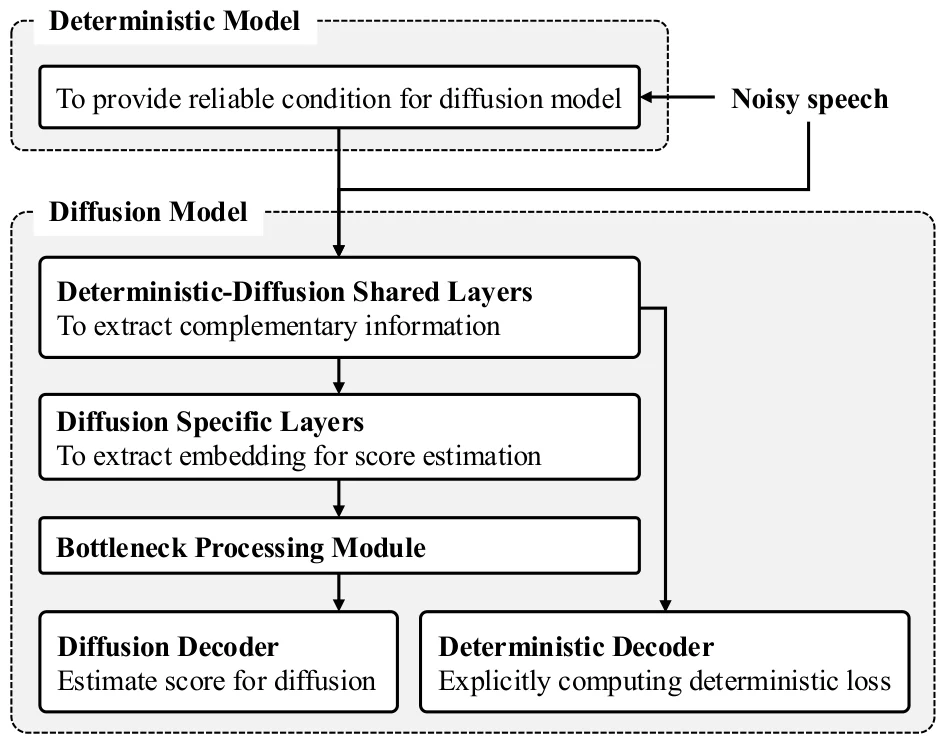
Figure from the paper: Combining Deterministic Enhanced Conditions With Dual-Streaming Encoding for Diffusion-Based Speech Enhancement
Motivation
Diffusion-based speech enhancement needs reliable conditions, but noisy features make poor ones. Features enhanced by deterministic models are an option, yet their distortion and information loss can affect the diffusion process.
Method
The paper first compares deterministic-only and deterministic-noisy conditions, then proposes DERDM-SE, a dual-streaming encoding Repair-Diffusion model that uses both, with a deterministic model combining coarse- and fine-grained processing.
Results
On CHiME-4, the proposed models leverage deterministic models effectively, achieving better enhancement scores and more stable performance than other diffusion-based SE models.
Abstract

Diffusion-based speech enhancement (SE) models need to incorporate correct prior knowledge as reliable conditions to generate accurate predictions. However, providing reliable conditions using noisy features is challenging. One solution is to use features enhanced by deterministic methods as conditions. However, the information distortion and loss caused by deterministic methods might affect the diffusion process. In this paper, we first investigate the effects of using different deterministic SE models as conditions for diffusion. We validate two conditions depending on whether the noisy feature was used as part of the condition: one using only the deterministic feature (deterministic-only), and the other using both deterministic and noisy features (deterministic-noisy). Preliminary investigation found that using deterministic enhanced conditions improves hearing experiences on real data, while the choice between using deterministic-only or deterministic-noisy conditions depends on the deterministic models. Based on these findings, we propose a dual-streaming encoding Repair-Diffusion Model for SE (DERDM-SE) to more effectively utilize both conditions. Moreover, we found that fine-grained deterministic models have greater potential in objective evaluation metrics, while UNet-based deterministic models provide more stable diffusion performance. Therefore, in the DERDM-SE, we propose a deterministic model that combines coarse- and fine-grained processing. Experimental results on CHiME4 show that the proposed models effectively leverage deterministic models to achieve better SE evaluation scores, along with more stable performance compared to other diffusion-based SE models.

IEEE Transactions on Audio, Speech and Language Processing, vol. 33, pp. 4253–4266, 2025.
Waveform-Domain Speech Enhancement Using Spectrogram Encoding for Robust Speech Recognition

Hao Shi, Masato Mimura, Tatsuya Kawahara

IEEE/ACM TASLP, 2024

Presents a waveform-domain speech enhancement method with spectrogram encoding for robust speech recognition.

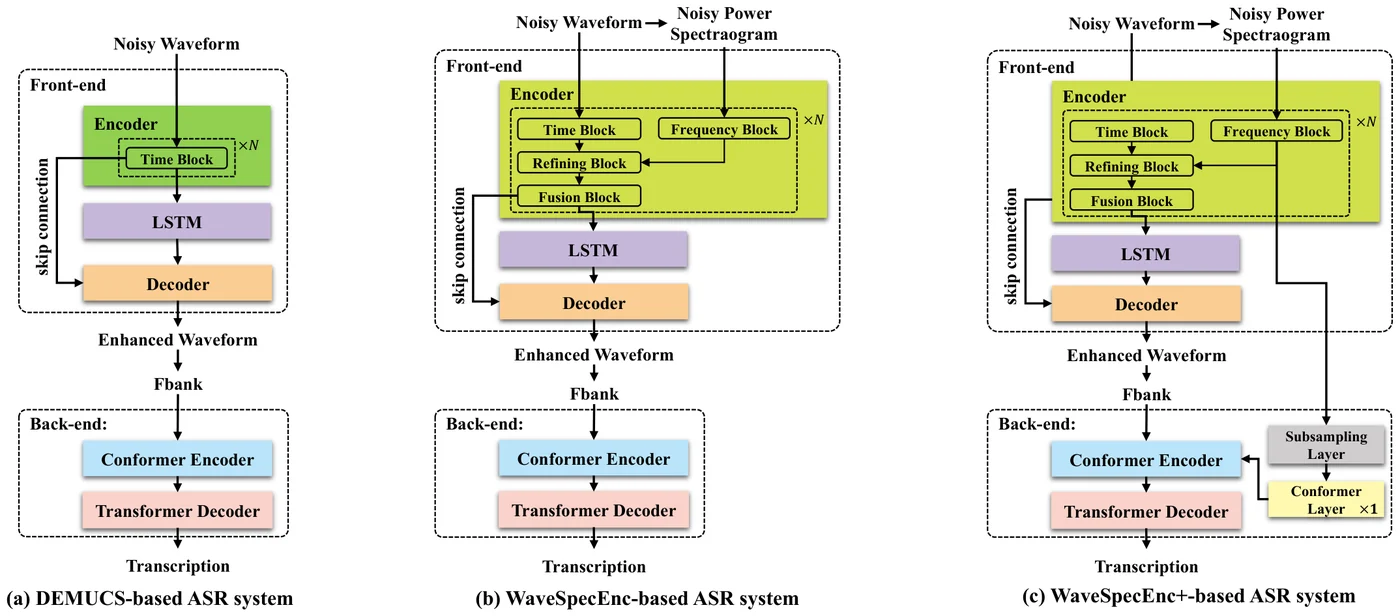
Figure from the paper: Waveform-Domain Speech Enhancement Using Spectrogram Encoding for Robust Speech Recognition
Motivation
Waveform-domain speech enhancement reaches state-of-the-art results on many datasets, while spectrogram-based enhancement tends to behave more robustly and stably.
Method
WaveSpecEnc, a waveform-spectrogram hybrid, refines the temporal feature map with spectrogram encoding in each encoder layer. WaveSpecEnc+ further passes spectrogram encoding information to both the enhancement front-end and the ASR back-end.
Results
On CHiME-4, ASR performance on real evaluation sets improves consistently and outperforms methods including DEMUCS and Conv-TasNet. Refining in shallow encoder layers is very effective, and the effect holds even with a strong WavLM-based ASR baseline.
Abstract

While waveform-domain speech enhancement (SE) has been extensively investigated in recent years and achieves state-of-the-art performance in many datasets, spectrogram-based SE tends to show robust and stable enhancement behavior. In this paper, we propose a waveform-spectrogram hybrid method (WaveSpecEnc) to improve the robustness of waveform-domain SE. WaveSpecEnc refines the corresponding temporal feature map by spectrogram encoding in each encoder layer. Incorporating spectral information provides robust human hearing experience performance. However, it has a minor automatic speech recognition (ASR) improvement. Thus, we improve it for robust ASR by further utilizing spectrogram encoding information (WaveSpecEnc+) to both the SE front-end and ASR back-end. Experimental results using the CHiME-4 dataset show that ASR performance in real evaluation sets is consistently improved with the proposed method, which outperformed others, including DEMUCS and Conv-Tasnet. Refining in the shallow encoder layers is very effective, and the effect is confirmed even with a strong ASR baseline using WavLM.

IEEE/ACM Transactions on Audio, Speech, and Language Processing, vol. 32, pp. 3049–3060, 2024.

Dual-path Adaptation of Pretrained Feature Extraction Module for Robust Automatic Speech Recognition

Hao Shi, Tatsuya Kawahara

INTERSPEECH, 2024

Figure from the paper: Dual-path Adaptation of Pretrained Feature Extraction Module for Robust Automatic Speech Recognition
Motivation
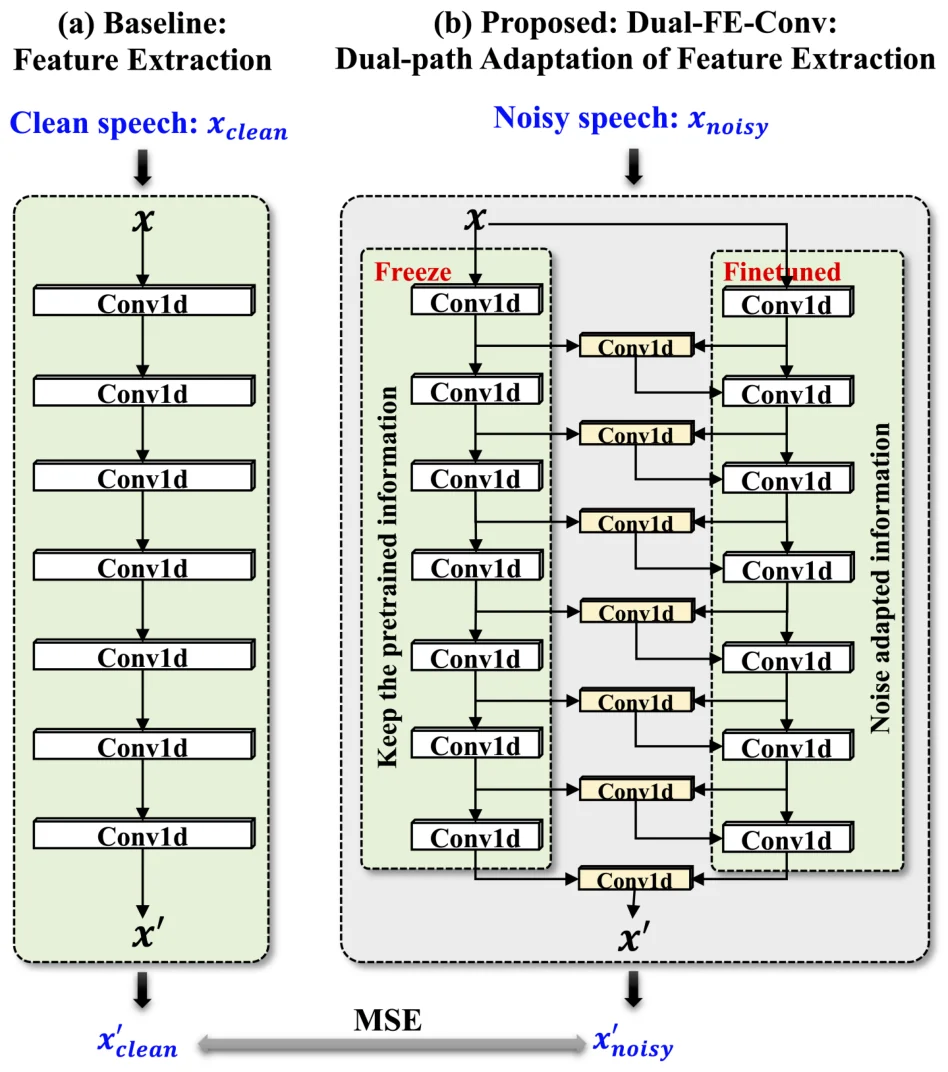
The feature extraction (FE) module of SSL models is usually frozen for ASR finetuning, but a severe mismatch between simulated and real noisy data calls for finetuning it without losing what was pretrained.
Method
Dual-path adaptation combines the frozen pretrained FE path with a finetuned, adapted FE path through convolutional fusion layers, with adapters inserted into the Transformer encoder.
Results
On CHiME-4, the method exploits the complementarity between the two FE paths, achieving significant improvements even with noise-robust WavLM models.
Abstract

Self-supervised learning (SSL)-based pretrained models have significantly improved automatic speech recognition (ASR) performance. As the feature extraction (FE) module has also been well-trained with a large amount of training data, freezing the FE during finetuning for downstream ASR tasks is common. When there is a severe mismatch between the simulated noisy data for pretraining and real noisy data, however, finetuning the FE with the real noisy data should be done without losing the effective information of the pretrained FE. In this paper, we propose a dual-path adaptation of the FE to address this problem. It combines the frozen pretrained FE path and the finetuned-adapted FE path with convolutional fusion layers. Moreover, adapters are inserted into the Transformer encoder. The experimental results using the CHiME–4 dataset show that using adapters for the FE or the Transformer encoder is effective, but achieving synergy of these two is challenging. Finetuning of the FE combined with adapters in the encoder realizes effective model adaptation. Moreover, the proposed method utilizes the complementarity between the pretrained and the finetuned FE paths, achieving significant improvements even with noise-robust WavLM models.

Proc. INTERSPEECH, pp. 2850–2854, 2024.

Diffusion-Based Speech Enhancement with Joint Generative and Predictive Decoders

Hao Shi, Kazuki Shimada, Masato Hirano, Takashi Shibuya, Yuichiro Koyama, Zhi Zhong, Shusuke Takahashi, Tatsuya Kawahara, Yuki Mitsufuji

IEEE ICASSP, 2024

Figure from the paper: Diffusion-Based Speech Enhancement with Joint Generative and Predictive Decoders
Motivation
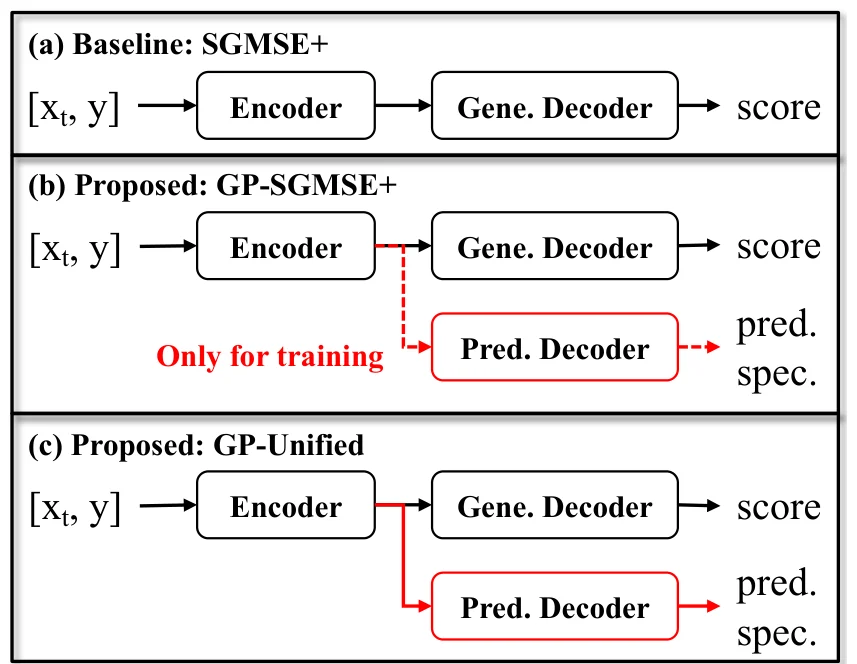
Reverse diffusion is time-consuming, and pipelines that initialize it with predictive enhancement do not make combined use of generative and predictive decoders.
Method
A unified system uses both decoders at two levels: a shared encoder holds generative and predictive information, and decoded features are fused at the initial diffusion step to improve convergence and at the final step to combine complementary outputs.
Results
On Voice-Bank, incorporating predictive information gives faster decoding and higher PESQ than the score-based diffusion systems StoRM and SGMSE+.
Abstract

Diffusion-based generative speech enhancement (SE) has recently received attention, but reverse diffusion remains time-consuming. One solution is to initialize the reverse diffusion process with enhanced features estimated by a predictive SE system. However, the pipeline structure currently does not consider for a combined use of generative and predictive decoders. The predictive decoder allows us to use the further complementarity between predictive and diffusion-based generative SE. In this paper, we propose a unified system that use jointly generative and predictive decoders across two levels. The encoder encodes both generative and predictive information at the shared encoding level. At the decoded feature level, we fuse the two decoded features by generative and predictive decoders. Specifically, the two SE modules are fused in the initial and final diffusion steps: the initial fusion initializes the diffusion process with the predictive SE to improve convergence, and the final fusion combines the two complementary SE outputs to enhance SE performance. Experiments conducted on the Voice-Bank dataset demonstrate that incorporating predictive information leads to faster decoding and higher PESQ scores compared with other score-based diffusion SE (StoRM and SGMSE+).

Proc. IEEE ICASSP, pp. 12951–12955, 2024.

All papers on this theme

02 Evidence Attribution

Multi-Talker & Speaker-Grounded Speech

Understand what was said, who said it, and which acoustic evidence belongs to which source in overlapping speech scenes.

Multi-Talker ASR · Speaker Grounding · Separation / TSE

Beyond Acoustic Prefixes: Persistent Access to Serialized Acoustic Memory for LLM-Based Multi-Talker Speech Recognition

Hao Shi, Yuan Gao, Xugang Lu, Tatsuya Kawahara

IEEE TASLP, 2026

Proposes memory grounding to improve large language model-based recognition in overlapping multi-talker speech.

Figure from the paper: Beyond Acoustic Prefixes: Persistent Access to Serialized Acoustic Memory for LLM-Based Multi-Talker Speech Recognition
Motivation
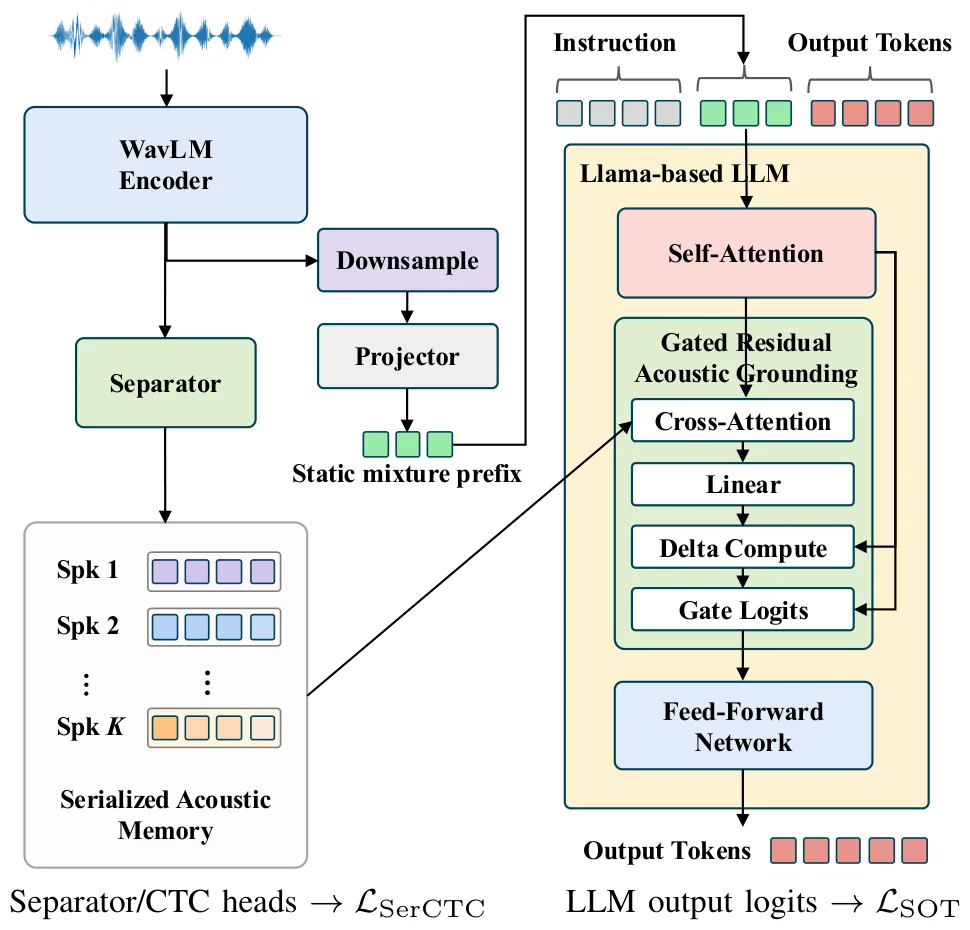
LLMs bring strong linguistic priors to serialized output training (SOT), yet LLM-based multi-talker ASR degrades substantially as the number of overlapping talkers grows. Acoustic evidence is exposed mainly through an initial mixture prefix, so the decoder must preserve and recover talker-relevant information indirectly throughout generation. Enriching that static prefix with CTC tokens, hybrid prompts, or continuous talker representations does not fully remove this bottleneck.
Method
Onset-based serialization is extended from the output target to the acoustic-conditioning pathway. Talker-specific representations are kept in utterance-onset order as external acoustic memory, and LLM layers query this memory throughout generation via gated residual cross-attention, while the mixture prefix remains a complementary global path. A second adaptation stage applies low-rank updates to the retrieval pathway and selected self-attention projections.
Results
Experiments on LibriMix show consistent improvements over static-prefix prompting: effective LLM-based multi-talker ASR depends not only on richer acoustic representations, but also on persistent access to evidence structured according to the serialized output.
Abstract

Large language models (LLMs) provide strong linguistic priors for serialized output training (SOT), yet LLM-based multi-talker ASR degrades substantially as the number of overlapping talkers increases. Conventional systems expose acoustic evidence primarily through an initial projected mixture prefix, requiring the decoder to preserve and recover talker-relevant information indirectly throughout autoregressive generation. We first examine whether this limitation can be resolved by enriching the static prefix using discrete connectionist temporal classification (CTC) tokens, hybrid token--acoustic prompts, and continuous talker-specific representations. The results suggest that acoustic content alone does not fully address the conditioning bottleneck. We therefore extend onset-based serialization from the output target to the acoustic-conditioning pathway and introduce persistent decoder-side access to SOT-aligned serialized acoustic memory. Talker-specific representations are organized in utterance-onset order and retained as external acoustic memory, while the conventional mixture prefix provides a complementary global-conditioning path. LLM layers query this memory throughout generation through gated residual cross-attention. We further introduce a second adaptation stage that jointly applies low-rank updates to the acoustic-retrieval pathway and selected LLM self-attention projections. Experiments on LibriMix show consistent improvements over static-prefix prompting. These results indicate that effective LLM-based multi-talker ASR depends not only on providing richer acoustic representations, but also on maintaining persistent access to acoustic evidence structured according to the serialized output.

IEEE Transactions on Audio, Speech and Language Processing, 2026.

Distilling LLM Semantic Priors into Encoder-Only Multi-Talker ASR with Talker-Count Routing

Hao Shi, Yusuke Fujita, Roman Koshkin, Mengjie Zhao, Yuan Gao, Lianbo Liu, Yui Sudo

INTERSPEECH, 2026

Figure from the paper: Distilling LLM Semantic Priors into Encoder-Only Multi-Talker ASR with Talker-Count Routing
Motivation
LLMs offer strong semantic priors for multi-talker ASR, but an autoregressive LLM decoder is computationally expensive and remains fragile under heavy overlap.
Method
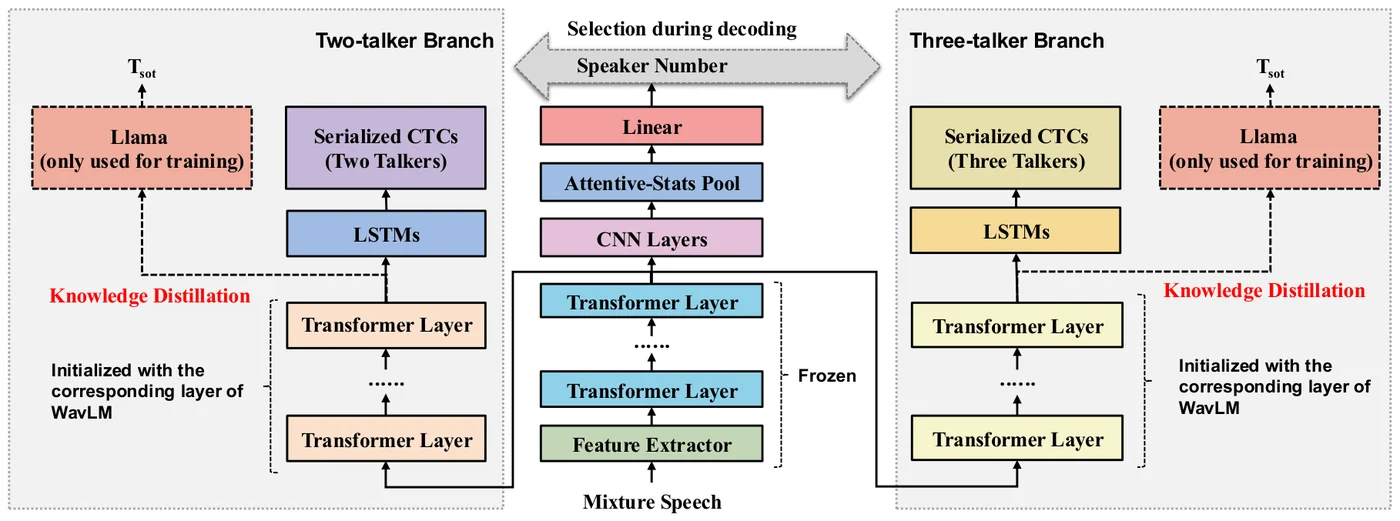
An encoder-only framework adapts an LLM to multi-talker conditioning and distills its semantic guidance into the encoder during training, keeping fast CTC-style decoding at inference. A post-encoder separator with serialized CTC produces talker-ordered transcripts, and a Talker-Count Head selects the decoding branch.
Results
On LibriMix, the encoder-only model is comparable to LLM-based systems with two talkers and significantly better with three, at a much smaller real-time factor.
Abstract

Large language models (LLMs) provide strong semantic priors that can improve multi-talker automatic speech recognition (MT-ASR), but using an LLM as an autoregressive decoder is computationally expensive and remains fragile under heavy overlap. In this paper, we propose an encoder-only MT-ASR framework that adapts an LLM to multi-talker conditioning and distills its semantic guidance into the encoder during training, while retaining fast CTC-style decoding at inference. Our model employs a post-encoder separator with serialized CTC to produce talker-ordered transcripts, and leverages an adapted LLM-based SOT objective as a multi-talker-aware teacher signal to explicitly regularize mixed-speech representations. To further support variable numbers of talkers, we introduce a Talker-Count Head that predicts the talker count and dynamically selects the appropriate decoding branch. Experiments on LibriMix show that the proposed encoder-only model achieves comparable performance to LLM-based systems in the two-talker condition, while delivering significant improvements in the three-talker condition with significant small RTF.

Proc. INTERSPEECH, 2026.

Serialized Output Prompting for Large Language Model-based Multi-Talker Speech Recognition

Hao Shi, Yusuke Fujita, Tomoya Mizumoto, Lianbo Liu, Atsushi Kojima, Yui Sudo

IEEE ASRU, 2025

Extracts serialized output prompts from mixed speech and uses them to guide an LLM for multi-talker ASR.

Figure from the paper: Serialized Output Prompting for Large Language Model-based Multi-Talker Speech Recognition
Motivation
Existing LLM-based multi-talker ASR systems omit prompts or rely on simple task-definition prompts; designing prompts to enhance performance had not been explored.
Method
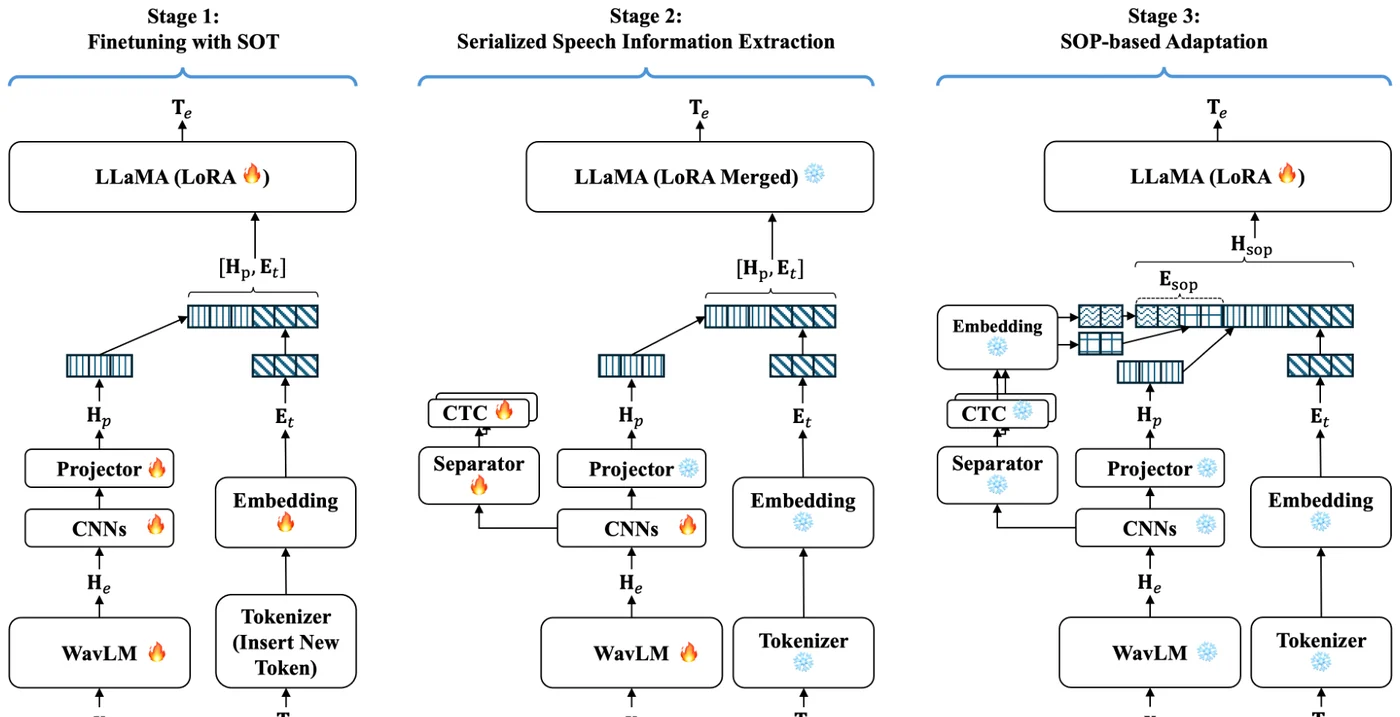
A separator and serialized CTC layers after the speech encoder extract multi-talker content in a first-speaking-first-out manner. Greedy decoding of the CTC outputs yields a serialized output prompt (SOP) for the LLM, trained in three stages: SOT fine-tuning, serialized speech information extraction, and SOP-based adaptation.
Results
On LibriMix, the LLM-based SOT model does well with two talkers but fails to fully leverage the LLM in harder conditions such as three talkers; SOP significantly improves performance in both two- and three-talker conditions.
Abstract

Prompts are crucial for task definition and for improving the performance of large language models (LLM)-based systems. However, existing LLM-based multi-talker (MT) automatic speech recognition (ASR) systems either omit prompts or rely on simple task-definition prompts, with no prior work exploring the design of prompts to enhance performance. In this paper, we propose extracting serialized output prompts (SOP) and explicitly guiding the LLM using structured prompts to improve system performance (SOP-MT-ASR). A Separator and serialized Connectionist Temporal Classification (CTC) layers are inserted after the speech encoder to separate and extract MT content from the mixed speech encoding in a first-speaking-first-out manner. Subsequently, the SOP, which serves as a prompt for LLMs, is obtained by decoding the serialized CTC outputs using greedy search. To train the model effectively, we design a three-stage training strategy, consisting of serialized output training (SOT) fine-tuning, serialized speech information extraction, and SOP-based adaptation. Experimental results on the LibriMix dataset show that, although the LLM-based SOT model performs well in the two-talker scenario, it fails to fully leverage LLMs under more complex conditions, such as the three-talker scenario. The proposed SOP approach significantly improved performance under both two- and three-talker conditions.

Proc. IEEE ASRU, 2025.

Serialized Speech Information Guidance with Overlapped Encoding Separation for Multi-Speaker Automatic Speech Recognition

Hao Shi, Yuan Gao, Zhaoheng Ni, Tatsuya Kawahara

IEEE SLT, 2024

Figure from the paper: Serialized Speech Information Guidance with Overlapped Encoding Separation for Multi-Speaker Automatic Speech Recognition
Motivation
Serialized output training is convenient and flexible for multi-speaker ASR, but it is hard to train with attention loss alone.
Method
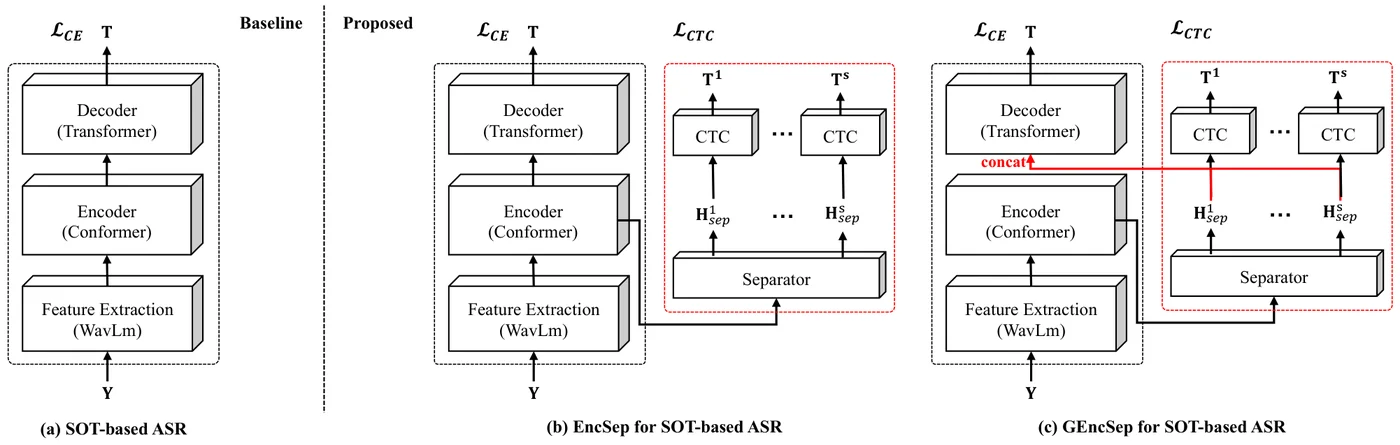
EncSep inserts a separator after the encoder to extract multi-speaker information with CTC losses, exploiting the CTC-Attention hybrid loss. GEncSep concatenates the separated streams to give single-speaker guidance to attention during decoding.
Results
On noisy Libri2Mix and Libri3Mix evaluation sets, EncSep gives relative improvements of more than 8% and 6%; GEncSep reaches more than 12% and 9%.
Abstract

Serialized output training (SOT) attracts increasing attention due to its convenience and flexibility for multi-speaker automatic speech recognition (ASR). However, it is not easy to train with attention loss only. In this paper, we propose the overlapped encoding separation (EncSep) to fully utilize the benefits of the connectionist temporal classification (CTC) and attention (CTC-Attention) hybrid loss. This additional separator is inserted after the encoder to extract the multi-speaker information with CTC losses. Furthermore, we propose the serialized speech information guidance SOT (GEncSep) to further utilize the separated encodings. The separated streams are concatenated to provide single-speaker information to guide attention during decoding. The experimental results on Libri2Mix and Libri3Mix show that the single-speaker encoding can be separated from the overlapped encoding. The CTC loss helps to improve the encoder representation under complex scenarios (three-speaker and noisy conditions), which makes the EncSep have a relative improvement of more than 8% and 6% on the noisy Libri2Mix and Libri3Mix evaluation sets, respectively. GEncSep further improved performance, which was more than 12% and 9% relative improvement for the noisy Libri2Mix and Libri3Mix evaluation sets.

Proc. IEEE SLT, pp. 193–199, 2024.

All papers on this theme

03 Grounded Modeling

Speech LLMs & Spoken Interaction

Leverage language-model and generative priors while keeping model decisions grounded in the observed speech.

Speech LLMs · Grounded Generation · Speech-to-Speech

Ruby-ASR: Evidence-Preserving Supervision for Joint Orthographic and Lexical-Reading Recognition

Hao Shi, Yun Liu, Xuehao Yang, Jun Liu, Chuanbo Hua, Xuanjun Chen, Lianbo Liu, Shiao Zhu, Zixiong Su

arXiv, 2026 · Preprint

Refines the Japanese ASR target into a span-bound sequence that binds each written span to its realized reading.

Figure from the paper: Ruby-ASR: Evidence-Preserving Supervision for Joint Orthographic and Lexical-Reading Recognition
Motivation
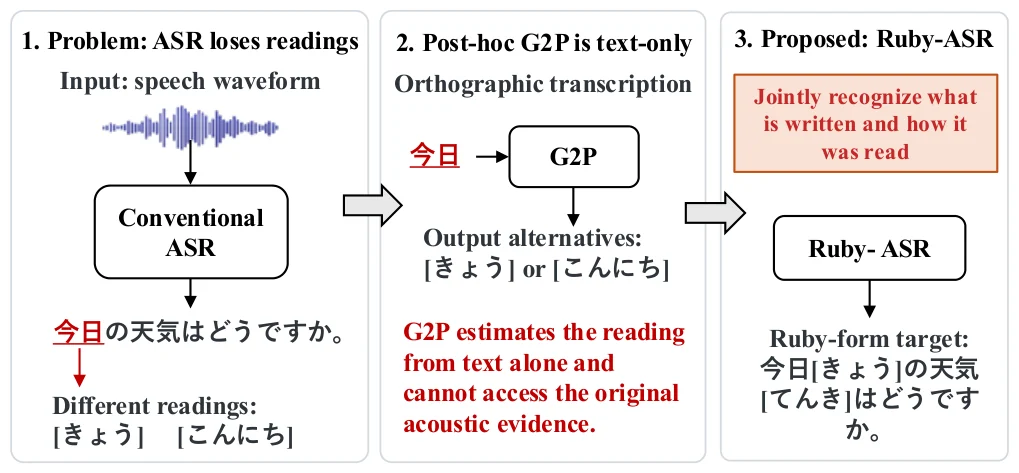
Japanese ASR is conventionally supervised by an orthographic transcript, although one written form can correspond to different lexical readings in speech. The reading distinction is absent from the supervision and cannot be recovered reliably by post-hoc, text-only grapheme-to-phoneme conversion.
Method
The target is refined into a span-bound orthographic and lexical-reading sequence: each written span is locally bound to its realized reading, and both views can be recovered deterministically. Built on a Qwen3-ASR backbone under subtitle-style and verbatim-style conventions, with a mora-level CTC objective as auxiliary monotonic reading supervision.
Results
Across five Japanese benchmarks, refining the recognition target improves lexical-reading recovery without sacrificing readable orthographic transcription. Checkpoints and inference code are released.
Abstract

Conventional Japanese automatic speech recognition (ASR) is supervised by an orthographic transcript, although the same written form can correspond to different lexical readings realized in speech. Such utterances receive an identical target, so their reading distinction is absent from the supervision interface and cannot be recovered reliably by post-hoc text-only grapheme-to-phoneme conversion. We present Ruby-ASR, which refines the conventional target into a span-bound orthographic--lexical-reading sequence. Unlike separate full-sentence orthographic and phonological outputs, the ruby representation locally binds each written span to its realized reading and permits deterministic recovery of both views. We instantiate the target under subtitle-style and verbatim-style transcription conventions using a Qwen3-ASR backbone; a mora-level CTC objective provides auxiliary monotonic reading supervision. The experimental results across five Japanese benchmarks show that refining the recognition target can improve lexical-reading recovery without sacrificing readable orthographic transcription. We release the checkpoints and inference code.

arXiv preprint arXiv:2609.27289, 2026.

Sarashina2.2-TTS: Tackling Kanji Polyphony in Japanese Speech Generation via Data Scaling and Targeted Data Synthesis

Lianbo Liu, Shiao Zhu, Kai Washizaki, Reo Yoneyama, Haesung Jeon, Mengjie Zhao, Yusuke Fujita, Hao Shi, Nao Yoshida, Yuan Gao, Roman Koshkin, Yukiya Hono, Yui Sudo

arXiv, 2026 · Preprint

Figure from the paper: Sarashina2.2-TTS: Tackling Kanji Polyphony in Japanese Speech Generation via Data Scaling and Targeted Data Synthesis
Motivation
LLM-based TTS has focused mostly on English and Chinese; Japanese remains under-explored, with challenges such as widespread context-dependent kanji polyphony.
Method
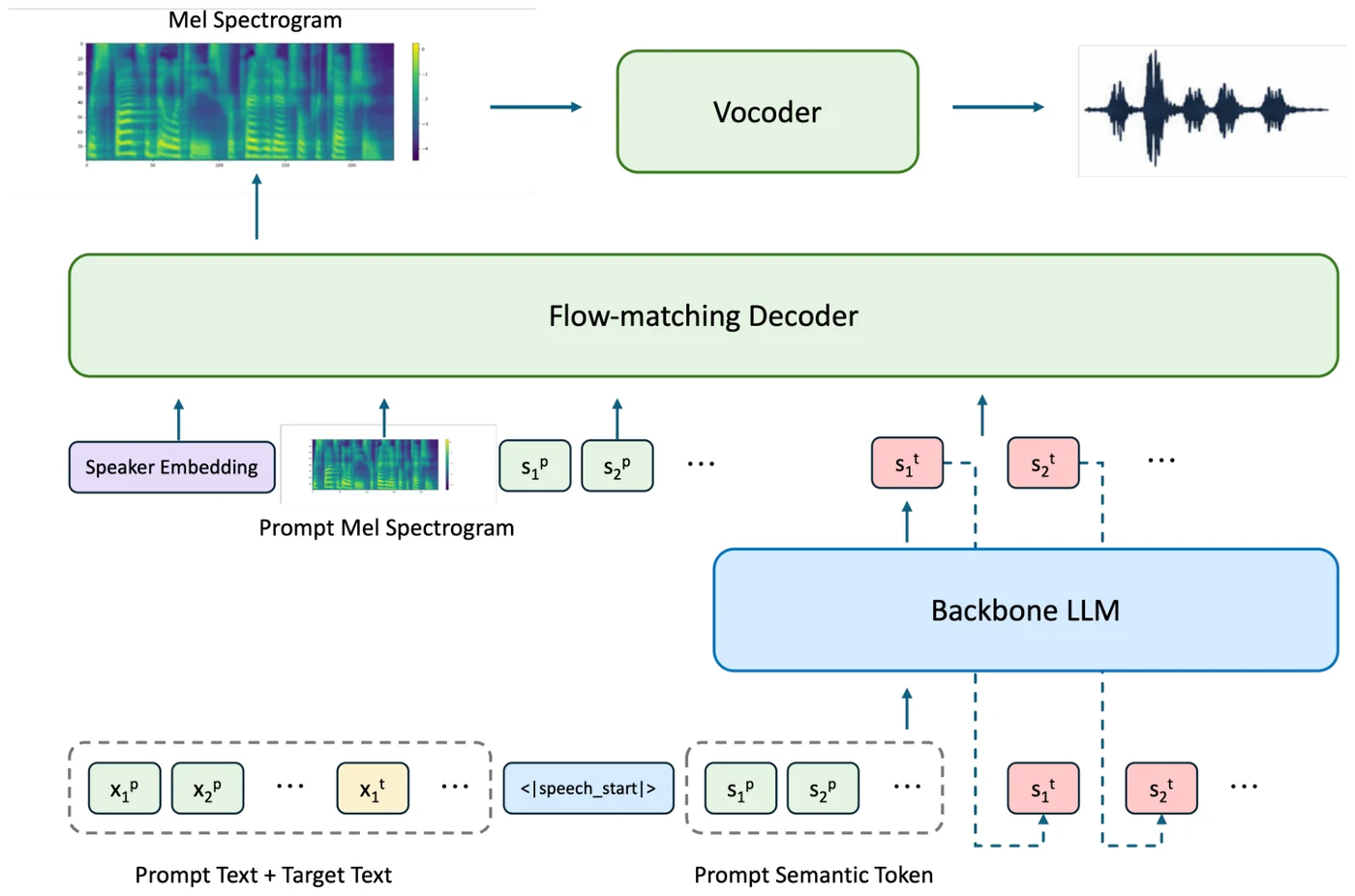
Training is scaled to about 361k hours of balanced Japanese and English speech, with targeted augmentation covering all 2,136 Joyo kanji. The Joyo Kanji Yomi Benchmark (4,378 readings) and the Kana-CER metric measure pronunciation correctness directly.
Results
State-of-the-art kanji-level reading accuracy, sentence-level pronunciation matching top baselines, and the highest speaker similarity in zero-shot Japanese synthesis, with stable Japanese pronunciation regardless of prompt language.
Abstract

While large language model (LLM)-based text-to-speech (TTS) systems have achieved high-quality speech synthesis, most existing systems focus on English and Chinese. Japanese, however, remains under-explored, and its unique linguistic challenges, such as widespread context-dependent kanji polyphony, have yet to be adequately tackled. Here we introduce Sarashina2.2-TTS (https://github.com/sbintuitions/sarashina2.2-tts), a Japanese-centric LLM-TTS system that tackles these challenges through a dual approach: data strategy and evaluation methodology. First, we scale training to approximately 361k hours of speech, incorporating a balanced mix of Japanese and English data. Furthermore, we design a targeted data augmentation pipeline covering all 2,136 Joyo (regular-use) kanji designated by Japan's Agency for Cultural Affairs to efficiently address kanji polyphony disambiguation. Second, we introduce the Joyo Kanji Yomi Benchmark (https://github.com/sbintuitions/JoyoKanji-Yomi-Benchmark), covering all 2,136 Joyo kanji and their 4,378 readings. Alongside this benchmark, we propose Kana-CER, a metric that compares synthesized speech against reference readings in the kana space, eliminating orthographic variations to directly measure pronunciation correctness. Experiments demonstrate that our targeted data augmentation significantly improves reading accuracy. Overall, Sarashina2.2-TTS achieves state-of-the-art kanji-level reading accuracy and matches top baselines on general sentence-level pronunciation, while delivering the highest speaker similarity in zero-shot Japanese speech synthesis. Furthermore, cross-lingual evaluation reveals that Sarashina2.2-TTS is the only system that maintains stable Japanese pronunciation regardless of the prompt language, confirming that our balanced training approach improves cross-lingual robustness.

arXiv preprint arXiv:2606.25369, 2026.

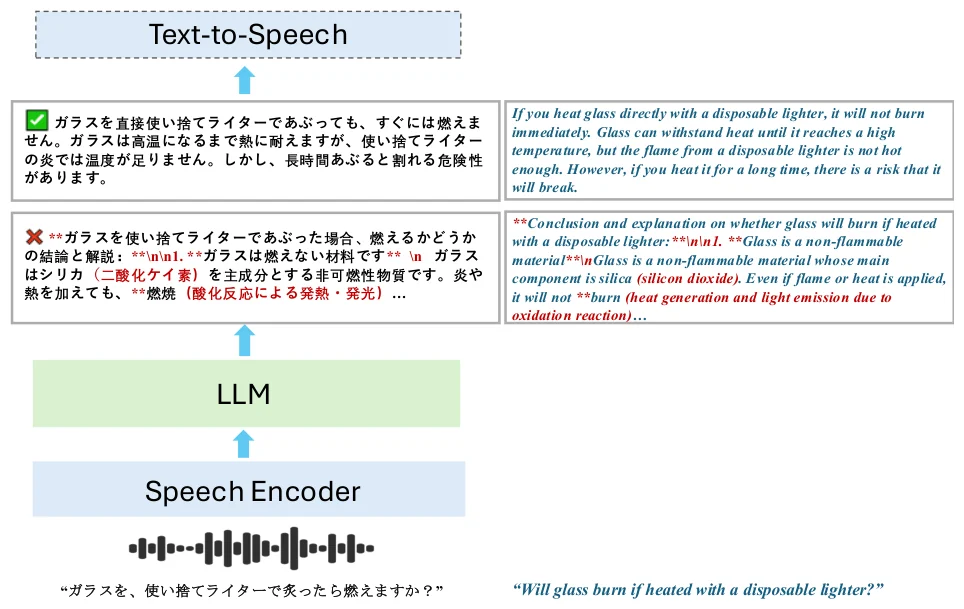
Speech-Worthy Alignment for Japanese SpeechLLMs via Direct Preference Optimization

Mengjie Zhao, Lianbo Liu, Yusuke Fujita, Hao Shi, Yuan Gao, Roman Koshkin, Yui Sudo

INTERSPEECH, 2026

Figure from the paper: Speech-Worthy Alignment for Japanese SpeechLLMs via Direct Preference Optimization
Motivation
SpeechLLMs inherit written-style output from text LLM backbones, which suits text-to-speech poorly. The mismatch is pronounced in Japanese, where spoken and written registers differ substantially.
Method
A preference-based alignment adapts Japanese SpeechLLMs toward concise, conversational, readily synthesized text, evaluated on SpokenElyza, a new benchmark derived from ELYZA-tasks-100 with auditory verification by native experts.
Results
Substantial improvement on SpokenElyza while largely preserving performance on the original written-style evaluation.
Abstract

SpeechLLMs typically combine ASR-trained encoders with text-based LLM backbones, leading them to inherit written-style output patterns unsuitable for text-to-speech synthesis. This mismatch is particularly pronounced in Japanese, where spoken and written registers differ substantially in politeness markers, sentence-final particles, and syntactic complexity. We propose a preference-based alignment approach to adapt Japanese SpeechLLMs for speech-worthy outputs: text that is concise, conversational, and readily synthesized as natural speech. To rigorously evaluate this task, we introduce SpokenElyza, a benchmark for Japanese speech-worthiness derived from ELYZA-tasks-100 with auditory verification by native experts. Experiments show that our approach achieves substantial improvement on SpokenElyza while largely preserving performance on the original written-style evaluation. We will release SpokenElyza to support future research on Japanese spoken dialog systems.

Proc. INTERSPEECH, 2026.

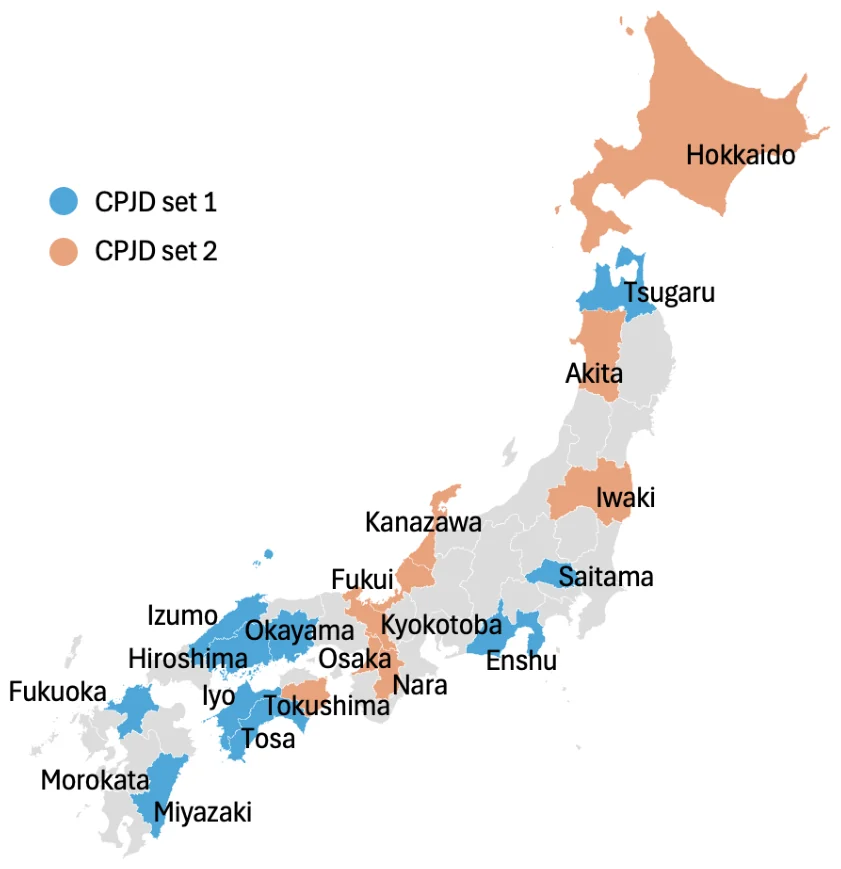
Evaluating Japanese Dialect Robustness Across Speech and Text-based Large Language Models

Tomoya Mizumoto, Yusuke Fujita, Hao Shi, Lianbo Liu, Atsushi Kojima, Yui Sudo

IEEE ASRU, 2025

Figure from the paper: Evaluating Japanese Dialect Robustness Across Speech and Text-based Large Language Models
Motivation
Dialectal variation remains a major challenge for spoken dialogue systems, and it is unclear how the dialect understanding of a base LLM affects speech language models.
Method
Robustness is defined as the ratio of performance on dialectal versus standard inputs, allowing fair comparison of LLMs and SLMs using Japanese dialects as a test case.
Results
SLM robustness correlates with that of the text-based counterpart; training with dialectal data and fine-tuning the speech encoder each improve robustness.
Abstract

Dialogue systems based on large language models (LLMs) have advanced significantly in recent years. However, dialectal variation remains a major challenge, particularly for systems that process spoken input. LLM-based speech language models (SLMs), which integrate LLMs with speech processing components, show promise for spoken language tasks, yet their ability to comprehend dialects has not been sufficiently studied. Moreover, it remains unclear how the dialectal understanding of the base LLM affects SLM performance. This study investigates the dialectal robustness of both LLMs and SLMs using Japanese dialects as a test case. We define robustness as the ratio of performance on dialectal versus standard inputs, enabling fair comparisons. Our experiments show that SLM robustness correlates with that of their text-based counterparts. Furthermore, training with dialectal data and fine-tuning the speech encoder each improves robustness in SLMs.

Proc. IEEE ASRU, 2025.

All papers on this theme